The Silence Protocol
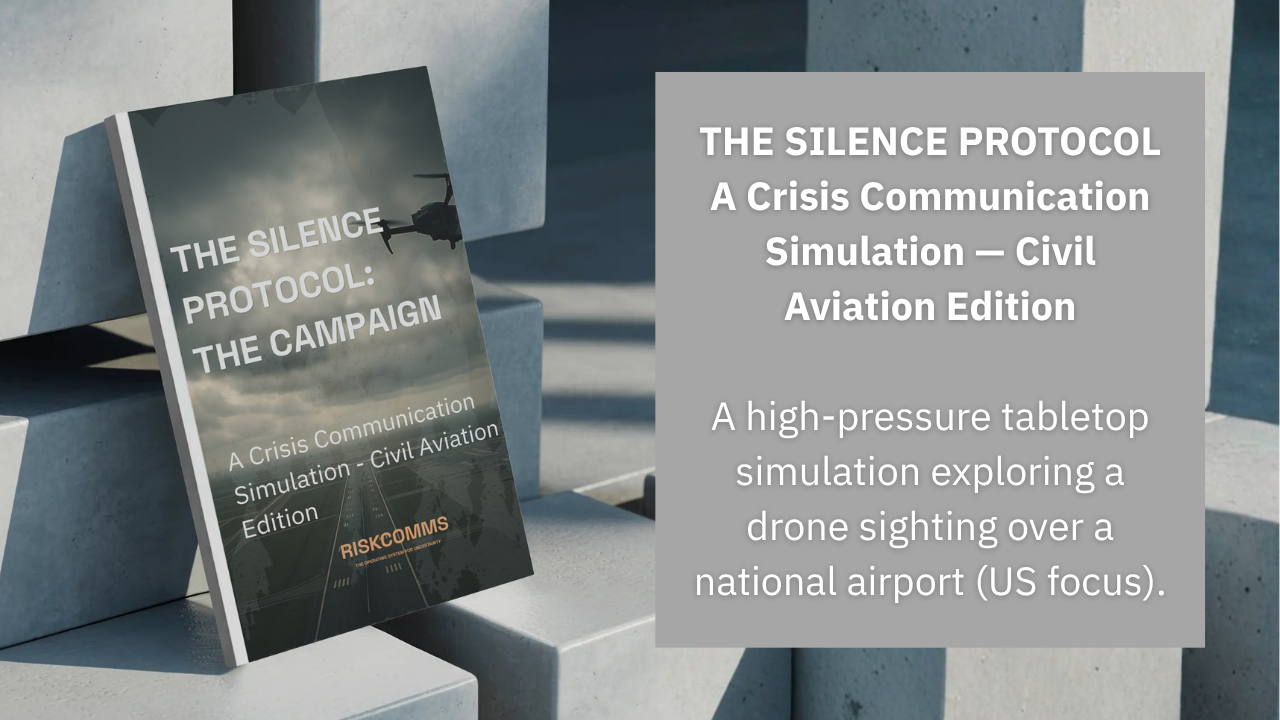
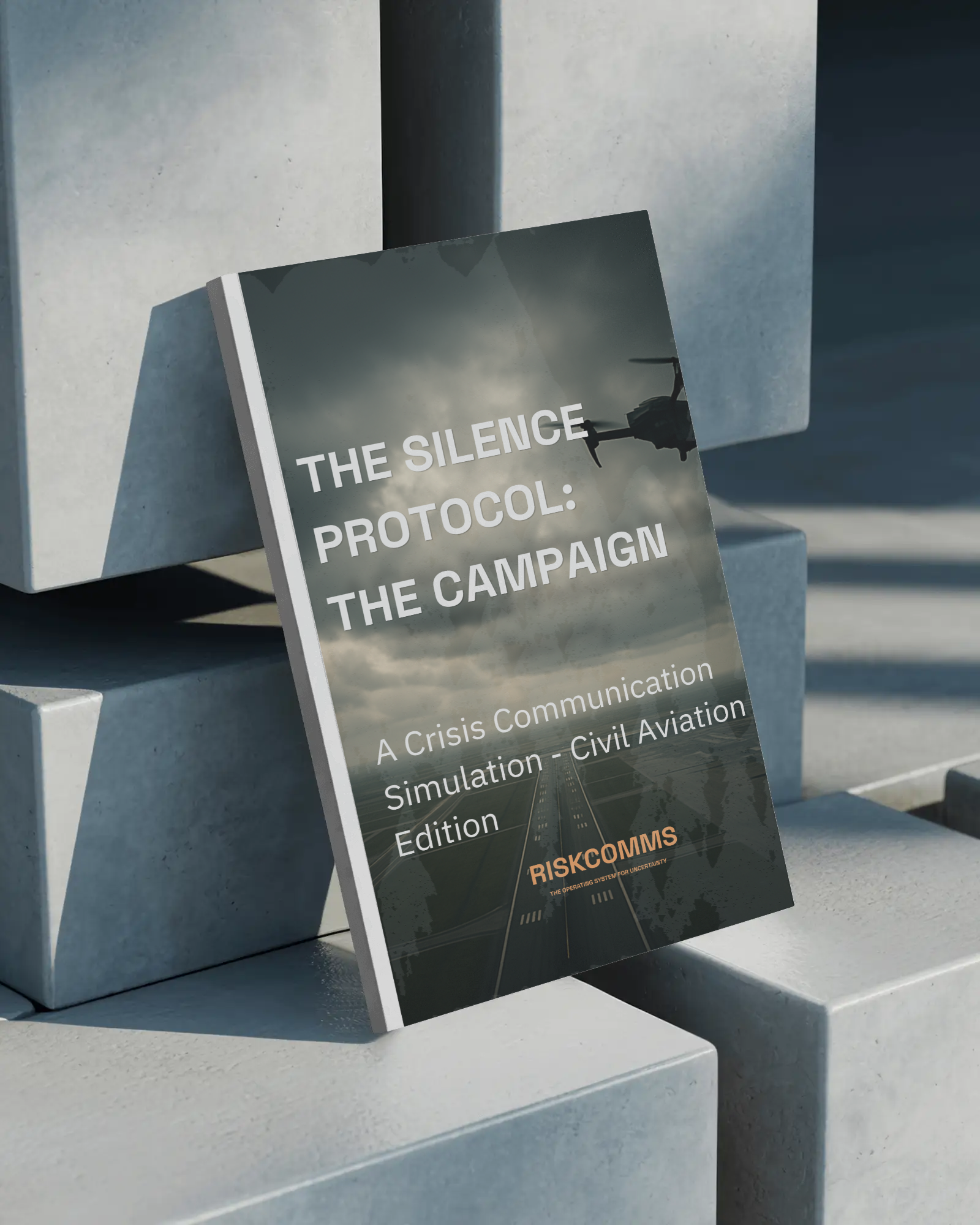
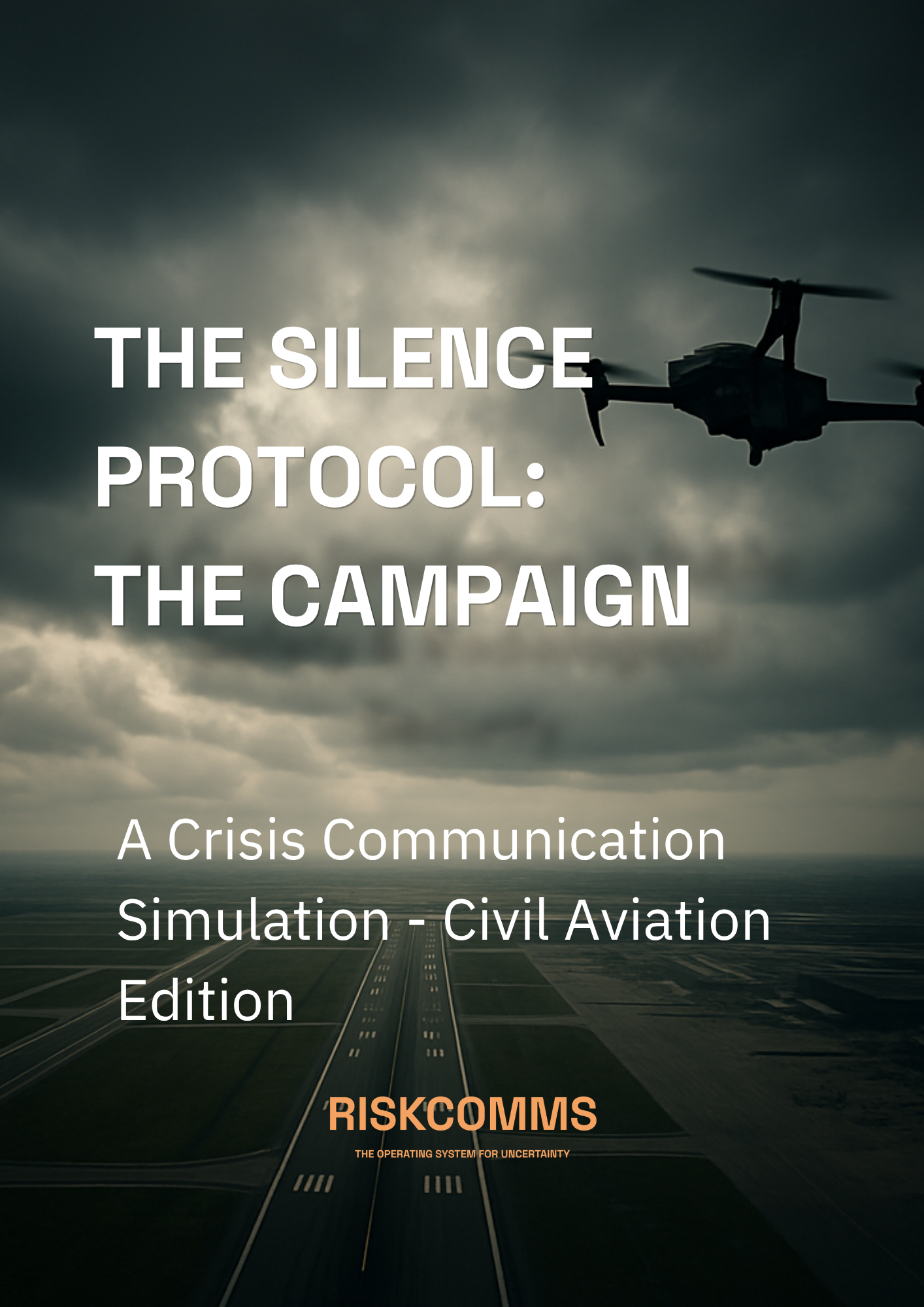
THE SILENCE PROTOCOL A Crisis Communication Simulation — Civil Aviation Edition RiskComms FZCO · Version 1.0 · 2026
Your airport just shut down. You have no footage. The sensors were offline. Three agencies are involved, and none of them are talking.
What do you say?
That's not a hypothetical. That's the exact situation crisis communicators face when a drone shuts down a civil airport and the facts refuse to cooperate. The shutdown may have been the right call. The problem is you can't prove it.
And the public — the passengers, the journalists, the local officials, the social media pile-on — won't wait while you figure out what you're allowed to say.
The Silence Protocol is a 33-page tabletop crisis simulation for aviation communications teams. It puts five to eight players inside the first forty hours of a drone incident at a US domestic airport, working with incomplete information, contradictory agency signals, and a narrative that is forming without them.
It runs in 90 to 120 minutes. It needs no special equipment. Just the zine, a dice roller, and a room with people who are willing to be honest about how hard this actually is.
What it simulates
A mid-size US domestic airport — Harlow Field, Caldwell, Ohio — suspends all operations after two crew members report a drone near the runway approach path. The FAA issues a Temporary Flight Restriction. Caldwell PD arrives at the perimeter. The FBI acknowledges the request for assistance.
No drone is confirmed. No footage exists. Both drone detection sensors were offline for scheduled maintenance. The airport says nothing for ninety-three minutes. When it does speak, it says very little.
That sentence becomes the story.
The simulation is not about the drone. It's about the silence. Who owns it? What fills it? And what it costs.
What makes this scenario hard
The airport cannot prove the threat was real. It cannot prove it wasn't. It cannot explain the sensor outage without opening a new line of questioning. It cannot speak for the FAA, the FBI, or the Caldwell PD — all of whom are saying different things, or nothing at all.
Legal is nervous. The Executive Director was unreachable for the first thirty-four minutes. The Comms Director has been in post for seven months. And the terminal is full of passengers who are filming everything.
This is the overreaction narrative. The most difficult frame to defend. Not because the institution did something wrong but because it can't explain what it did right.
How it works
The simulation runs in rounds. Each round is four hours of real time. Players are assigned roles — Comms Director, Executive Director, Security Director, Operations Manager, Legal Counsel, Airline Liaison, and Board Observer.
Each round produces a narrative event, a platform dynamics result, and an internal friction roll. The team has five minutes to discuss. One decision. One public signal — or a deliberate silence. Consequences apply immediately.
The Silence Clock tracks how long the airport goes without directly addressing the core accusation. Not the incident. The accusation. The longer the silence, the more the narrative hardens.
The Trust Tracker reflects how the team's signals land. Acknowledge emotional harm in plain language and gain ground. Defend institutional intent while passengers are stranded and lose it fast.
Four endgame states. None of them are comfortable. The learning is in the process, not the outcome.
Who it's for
Airport communications teams preparing for real UAS incidents. Crisis communication practitioners who work with aviation clients. Operations and security leadership who need to understand what the comms function actually requires of them under pressure. Leadership teams who have a crisis plan and have never tested whether it survives contact with a multi-agency response and a hostile narrative.
It also works as a standalone professional development exercise for any communications team that wants to stress-test its decision-making when the facts are thin, the lawyers are cautious, and the clock is running.
What's in the zine
Thirty-three pages. A4 format. Black and white interior. Print it or run it from a screen. No special materials are required, the dice roller and timer links are on Page 3.
Inside: full scenario briefing, role cards, the Silence Clock mechanic, a complete decision loop, ten narrative event tables, six platform dynamics scenarios, internal friction and resource strain tables, symbolic pressure points, the Trust Tracker, late-stage complications, four endgame states, and a facilitated debrief with five discussion prompts ready to use.
Everything the facilitator needs. Nothing they don't.
A note on the scenario
Harlow Field does not exist. But the mechanics are drawn from how drone incidents at US airports have actually unfolded — the jurisdictional confusion, the communication paralysis, the public narrative that forms in the information vacuum. The scenario is fictional. The pressure is not.
The Silence Protocol is part of the RiskComms crisis simulation series, developed by Philippe Borremans — Crisis, Risk & Emergency Communication Consultant, with 25+ years of field experience across 50+ countries.


RISKCOMMS - Crisis, Risk and Emergency Communication Tools
Professional-grade infrastructure for crisis and emergency communication.
Welcome to the Crisis Resource Hub. This is a dedicated library of operational tools for communication leaders, emergency managers, and corporate resilience teams.
Rather than theoretical advice, you will find practical, field-tested assets divided into two core collections: Planning Infrastructure (templates, frameworks, and workbooks to build your response capability) and Readiness Simulations (scenario-specific tabletop exercises to stress-test your team).
Built by Philippe Borremans, independent crisis consultant and author, these tools are used by multinational corporations, government agencies, and NGOs worldwide to navigate polycrisis environments with clarity and confidence.
What You'll Get:
- Thirty-three pages. A4 format. Black and white interior.
- Print it or run it from a screen. No special materials are required
- Inside: full scenario briefing, role cards, the Silence Clock mechanic, a complete decision loop, ten narrative event tables, six platform dynamics scenarios
- Internal friction and resource strain tables, symbolic pressure points, the Trust Tracker, late-stage complications
- Four endgame states, and a facilitated debrief with five discussion prompts ready to use.
- 1 Files
-
SILENCE PROTOCOL.pdf
4.4 MB -
55 pages (~7,115 words)